


Orientation is one of the first decisions you make on a Murphy bed build. This determines where the bed goes in the room, ceiling clearance, cabinet dimensions, and which mechanism you will use.
You might be able to choose freely between either option, but if not, it's a constraints question first, and a preferences question second. Get the room constraints right first, and the orientation decision often enough makes itself.
What Vertical and Horizontal Actually Mean
These terms describe how the mattress is stored — specifically, which axis of the mattress runs floor-to-ceiling when the bed is closed.
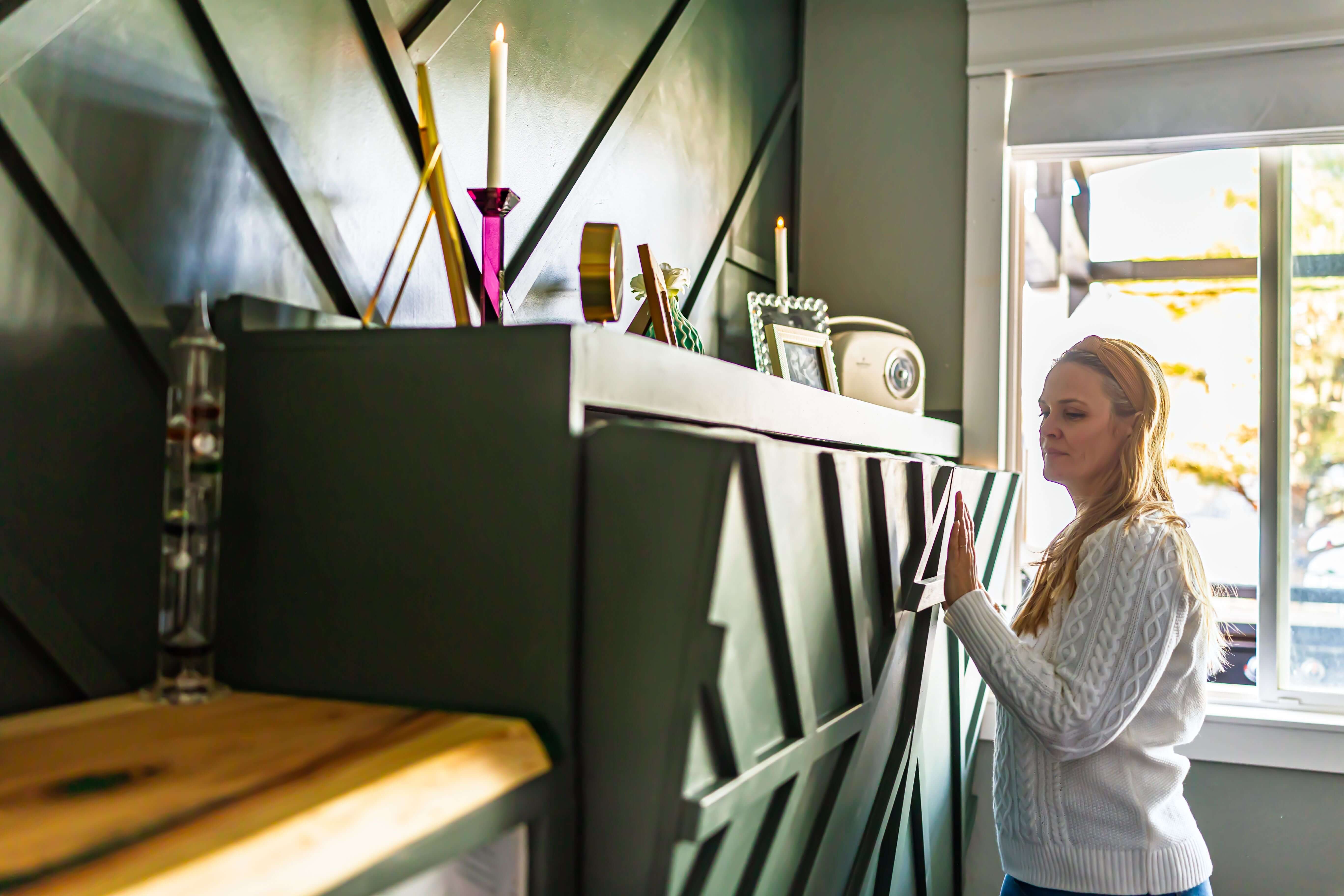
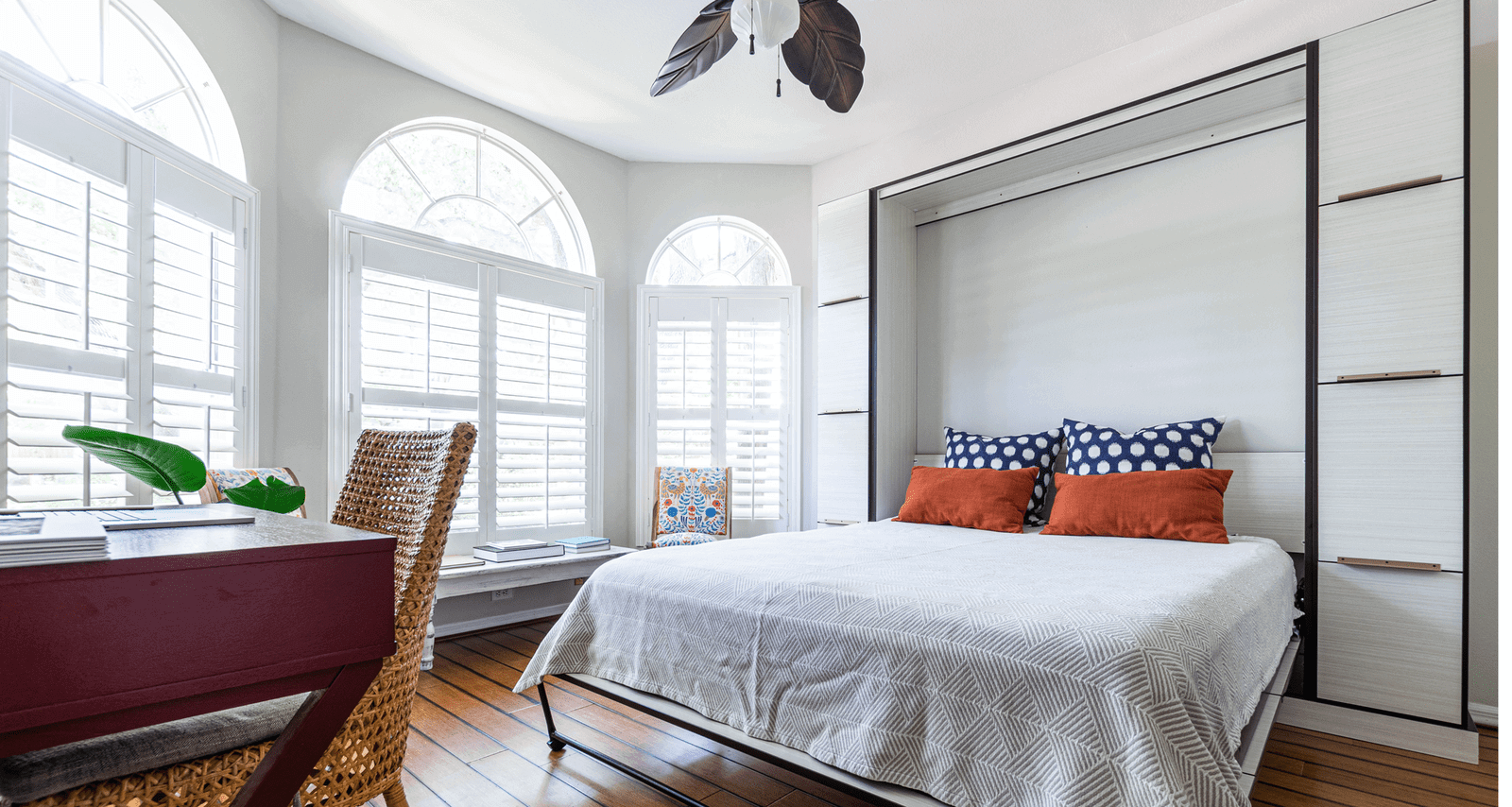
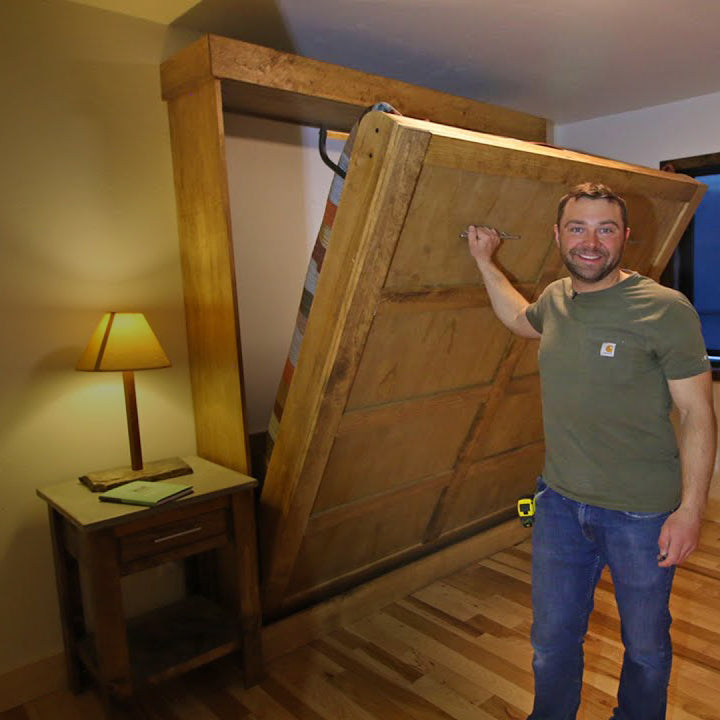
Vertical (upright): The mattress is stored standing on its end. The long axis of the mattress — head to foot — is oriented vertically inside the cabinet. The cabinet is tall and narrow compared to its width. When you pull the bed down, it opens horizontally at roughly body height.
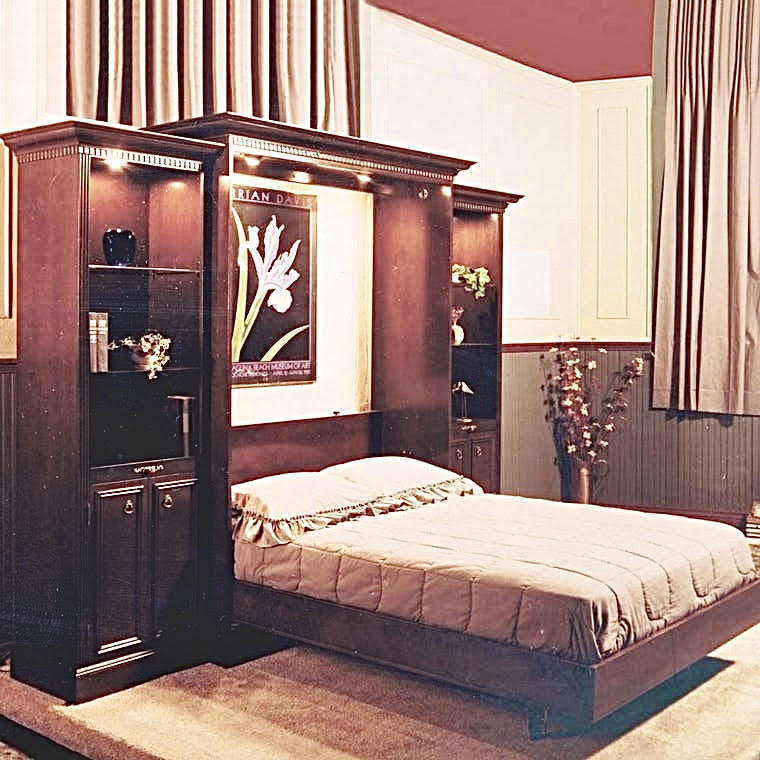
Horizontal (side): The mattress is stored on its side, with the long axis running parallel to the wall. The minimum cabinet requirements are wider and lower than a vertical Murphy bed. The bed folds out toward you rather than opening down from above.
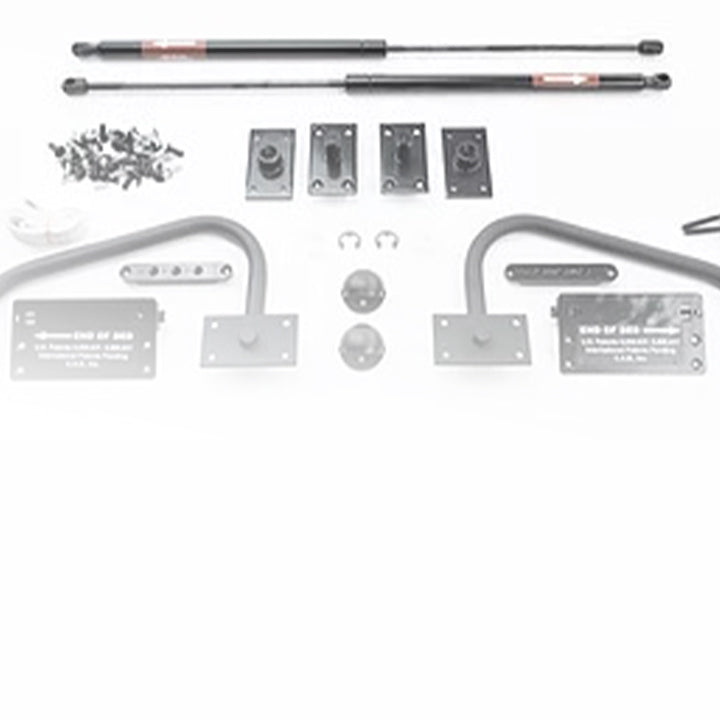
Both styles use high-quality, made-in-the-USA gas piston mechanisms from Create-A-Bed — the orientation determines which instruction set and cut list applies; you choose whether you want to use a Standard, Deluxe, or Adjustable kit.
The Numbers That Drive the Decision
While you’re inspecting the room, and before you sketch anything, print out these dimensions and take them with you. These are finished cabinet dimensions — outside edge to outside edge — for cabinets built using Create-A-Bed mechanisms with 3/4" plywood.
Vertical Cabinet Dimensions
|
Size |
Cabinet Height |
Cabinet Width |
Depth |
Room Projection |
|---|---|---|---|---|
|
Twin |
82-1/8" |
44-7/8" |
15-7/8" |
83" |
|
Full |
82-1/8" |
59-7/8" |
15-7/8" |
83" |
|
Queen |
87-1/8" |
65-7/8" |
15-7/8" |
87" |
|
King |
87-1/8" |
81-7/8" |
15-7/8" |
87" |
Horizontal Cabinet Dimensions
|
Size |
Cabinet Height |
Cabinet Width |
Depth |
Room Projection |
|---|---|---|---|---|
|
Twin |
47-3/8" |
80-7/8" |
15-7/8" |
46" |
|
Full |
62-7/16" |
80-7/8" |
15-7/8" |
61" |
|
Queen |
68-7/16" |
85-7/8" |
15-7/8" |
67" |
|
King |
83-1/8" |
85-7/8" |
15-7/8" |
83" |
Let’s talk through some of these numbers and what they may mean for your build specifically:
-
Both orientations share the same 15-7/8" cabinet depth regardless of which way the bed opens.
-
A vertical Queen cabinet is 87-1/8" tall. Standard 8-foot ceilings give you 96" to work with. Be sure to account for finish floor height and any crown molding before you commit.
-
A horizontal Twin projects only 46" into the room when open. A vertical Twin projects 83". For smaller rooms, 37 added inches in length can make a big difference.
-
A horizontal Queen only needs 68-7/16" of wall height — that's well inside an 8-foot ceiling. But it needs 85-7/8" of uninterrupted wall width. If that wall has a window or doorway in it, horizontal may not be viable at Queen size.
Ceiling Height Is the First Filter
What is the actual clearance from the finished floor to the lowest obstruction on the wall you propose to use for your Murphy bed?
Make sure you account for:
-
Finished floor height (hardwood over subfloor can add 1-1/2" or more)
-
Base molding at the cabinet base — both orientations require you to cut out base molding if present, so the cabinet can sit flush to the wall
-
Soffits, HVAC drops, or structural elements above the bed location
-
Crown molding, if the cabinet will be built to the ceiling line
With those deductions in mind, a standard 8-foot room often leaves 94" or less of usable vertical space. Here's how that applies to orientation options:
-
Vertical Twin or Full: Both cabinet heights are 82-1/8" — comfortably inside 94" of usable clearance.
-
Vertical Queen or King: Cabinet height hits 87-1/8". Still fits a standard 8-foot room after accounting for typical deductions, but measure before you commit — there's no margin for error on tight ceilings.
-
Horizontal (all sizes): Maximum cabinet height is 83-1/8" (King). Every horizontal size fits comfortably under a standard 8-foot ceiling.
Rooms with 9-foot or taller ceilings open up the full list of options from twin to king. If the client has a 9-foot room, his ceilings will not dictate the decision — rather, the question shifts to wall width and the particular use case your client has in mind.
|
One thing to double-check on vertical builds: The projection into the room when the bed is open must also be unobstructed floor space. A vertical Queen projects 87" from the wall. That's more than seven feet of clear floor needed in front of the cabinet. If the room isn't deep enough to accommodate that, you have a problem regardless of ceiling height. |
Wall Width and Layout Constraints
After ceiling height, wall space is the second hard constraint.
Horizontal beds need a longer run of wall. A horizontal Queen requires 85-7/8" of unobstructed width — that's just over seven feet without a window, doorway, or outlet interrupting the span. For many rooms, that's harder to find than it may sound. A horizontal King needs essentially the same width (85-7/8") but adds substantially more height and projection.
Vertical beds need wall height, not wall width. A vertical Twin cabinet is under 45" wide — you can fit one on a wall that would never accommodate a horizontal bed at any size. That narrow footprint is often the whole reason to choose vertical in the first place.
Layout implications worth noting:
-
Horizontal beds work naturally with flanking side cabinets or shelving, since the shorter cabinet height leaves open wall space above. A horizontal Queen at 68-7/16" still has more than two feet of wall visible above it in an 8-foot room.
-
Vertical beds lend themselves to full-height built-in treatments — cabinets or bookshelves on either side at matching height are usually a good complement to the build. The tall cabinet reads as a floor-to-ceiling furniture wall. And it is, until you open it.
Is the Room Doubling as an Office?
If the project involves a combined home office and guest room, the orientation question may already be answered before you pull out a tape measure.
Create-A-Bed's Premium Adjustable Bed + Desk Mechanism Bundle integrates a fold-down work surface with the Murphy bed mechanism into a single vertical build. The desk deploys when the bed is closed, transforming the same footprint into a functional workstation. When the guest arrives, the desk folds away and the bed comes down.
This bundle is a vertical-only solution. There's no horizontal equivalent of the integrated desk mechanism yet. If a client asks about a Murphy bed office combo, confirm early whether the desk bundle is on the table. If it is, assume you’ll be building vertically.
Is One Orientation Harder to Build?
The honest answer: comparable skill level, different practical challenges.
The cut lists for vertical and horizontal are different, but neither is dramatically more complex than the other. Both require the same basic operations — ripping sheet goods to width, dado cuts for hardware recesses, assembly in place or pre-assembled sections moved into position.
One constant across both: the inner wood bed frame is constructed from solid wood (poplar, clear pine, maple), while specific structural components like side rails must be 3/4" plywood. Don't substitute materials without checking with Create-A-Bed.
Visual Character and Use Case Fit
The technical case leads the decision by determining what options are on the table, but it's worth understanding how each orientation reads in a finished room — particularly when you're advising a client on what they're actually getting and the room doesn’t restrict your choices.
Vertical builds look like a built-in armoire or wardrobe when closed. The tall, narrow cabinet reads as general, stylish storage, not as a bed. In rooms with higher ceilings or where the full wall is being treated as a built-in system, a vertical bed anchors the wall and invites flanking elements that extend the cabinet line. It's a natural fit for a dedicated guest room or ADU where the bed is the room's primary feature.
Horizontal builds read lower and wider — more like a large cupboard, a high sideboard, or credenza. The shorter cabinet height leaves wall space above, which works well for art, floating shelves, or TV placement. In a room where you are trying to make the bed disappear as thoroughly as possible into the surrounding furniture, horizontal may integrate more naturally with the rest of the space.
Quick Decision Framework
Before you finalize orientation, run through these in order:
-
What is the finished floor-to-obstruction clearance on the target wall? This sets the ceiling constraint and immediately eliminates some vertical options in lower-ceiling rooms.
-
How much uninterrupted wall width is available? Less than 86" means a horizontal Queen or King size won’t fit. Less than 45" means nothing bigger than a vertical Twin fits at all.
-
How deep is the room? Both orientations need clear floor space for the open bed. Vertical builds project significantly more than horizontal at the same bed size — critical in narrow rooms.
-
Is a desk combo part of the scope? If yes, assume you’ll be building vertical.
-
What bed size is required? King-sized builds have significant size requirements in either orientation. Confirm room dimensions before discussing size; it can rule a lot of your options out right off the bat.
Create-A-Bed's mechanism kits support both vertical and horizontal builds across Twin, Full, Queen, and King sizes. If you're working through the orientation decision on a specific room, the dimensions above give you the exact finished cabinet footprint.
|
Not sure which mechanism kit fits your orientation and size? Create-A-Bed's team is available to walk through the specs with you before you buy. USA-based support, no runaround or sending your call overseas. |
The Orientation Dictates the Rest of the Build
Get this one right and the rest of the build has a solid foundation. The good news is: the constraints are concrete and measureable. Measure the ceiling, the wall, the room depth, and ask about the desk combo. Four questions, and the right choice is usually obvious with those answers in hand.
If you're still working through the geometry on a specific job — or you want to confirm which mechanism kit fits before you order — Create-A-Bed's team is available to walk through the specs with you directly. We’ve been building these mechanisms since 1985 and our knowledge of Murphy bed builds is absolutely comprehensive.
Get your Murphy bed mechanism kit or contact our team today!